On expectations, delivery and how we take responsibility in a way that builds trust in our change management projects.
You’ve done your best to keep the work moving forward, but the figures still don’t add up and the schedule isn’t being met. This raises a question that is rarely discussed: what is the difference between explaining the challenges in the project and actually taking responsibility for driving the change forward?
A familiar situation
We often work on projects where the circumstances turn out to be more complex than expected. The information needed to move forward is harder to obtain than anticipated. Along the way, assumptions are made, and some of them turn out to be wrong. No one has acted to hinder the work, but the result is nonetheless that progress slows down and time is spent on things that do not create value.
The issue comes to a head when the situation needs to be communicated to those you are working with. How do you explain what has been difficult and why things have taken time, so that you take responsibility without shifting the blame and build trust rather than eroding it?
When the press takes over
In The 15 Commitments of Conscious Leadership, Jim Dethmer, Diana Chapman and Kaley Warner Klemp describe how, under pressure, we often slip into a reactive mode without realising it. The need to be right takes precedence over the desire to understand. We look for explanations that keep us removed from the problem rather than those that help us work through it.
It is not that we lack integrity or judgement. It is an automatic reaction that most people recognise, and it is strongest precisely when we have done our best and still failed to get through. Being able to recognise the pattern is what distinguishes reacting from choosing how to act.
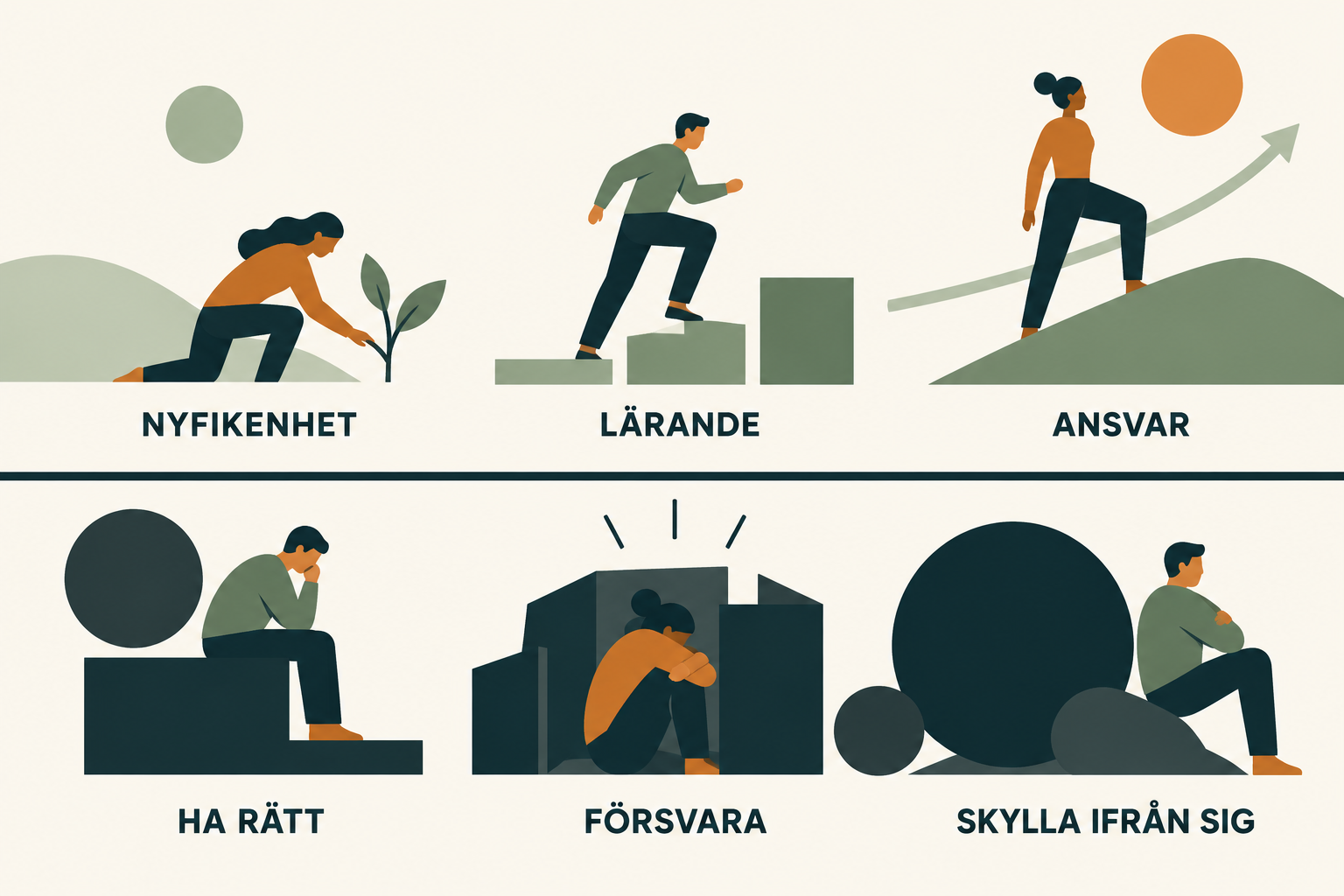
Above and below the line. Freely adapted from Dethmer, Chapman and Warner Klemp, The 15 Commitments of Conscious Leadership.
Deceptive self-criticism
Once we realise that something could have been done differently, self-criticism easily takes over. We should have asked those questions sooner. We should have double-checked that assumption straight away. It feels like taking responsibility, but it rarely is.
Self-criticism and taking responsibility are not the same thing. Self-criticism focuses its energy on punishing one’s self-image, not on understanding what happened and being able to act differently in future. If, instead, you treat yourself as you would treat a colleague in the same situation, that energy is freed up for something more useful.
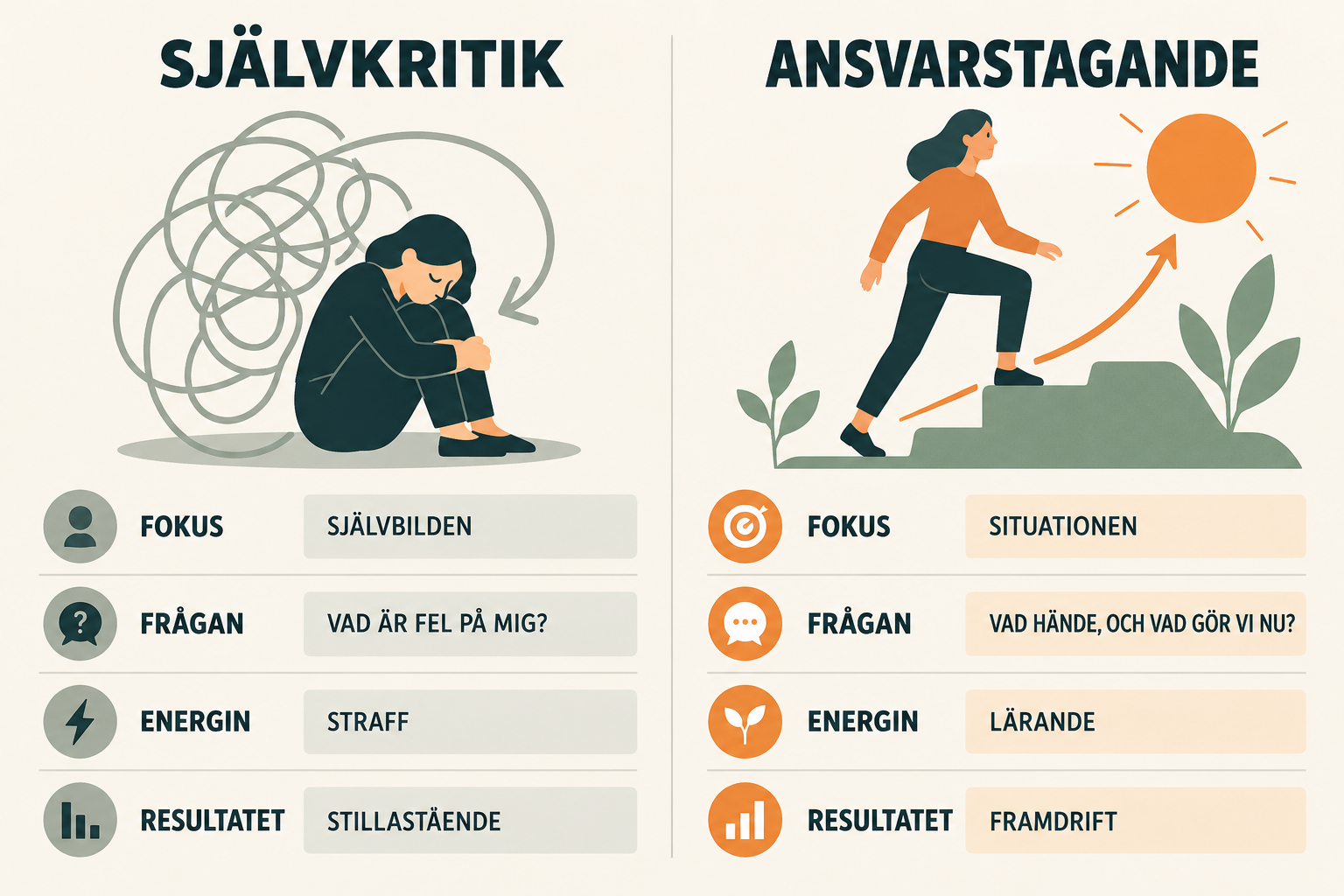
Självkritik och ansvarstagande
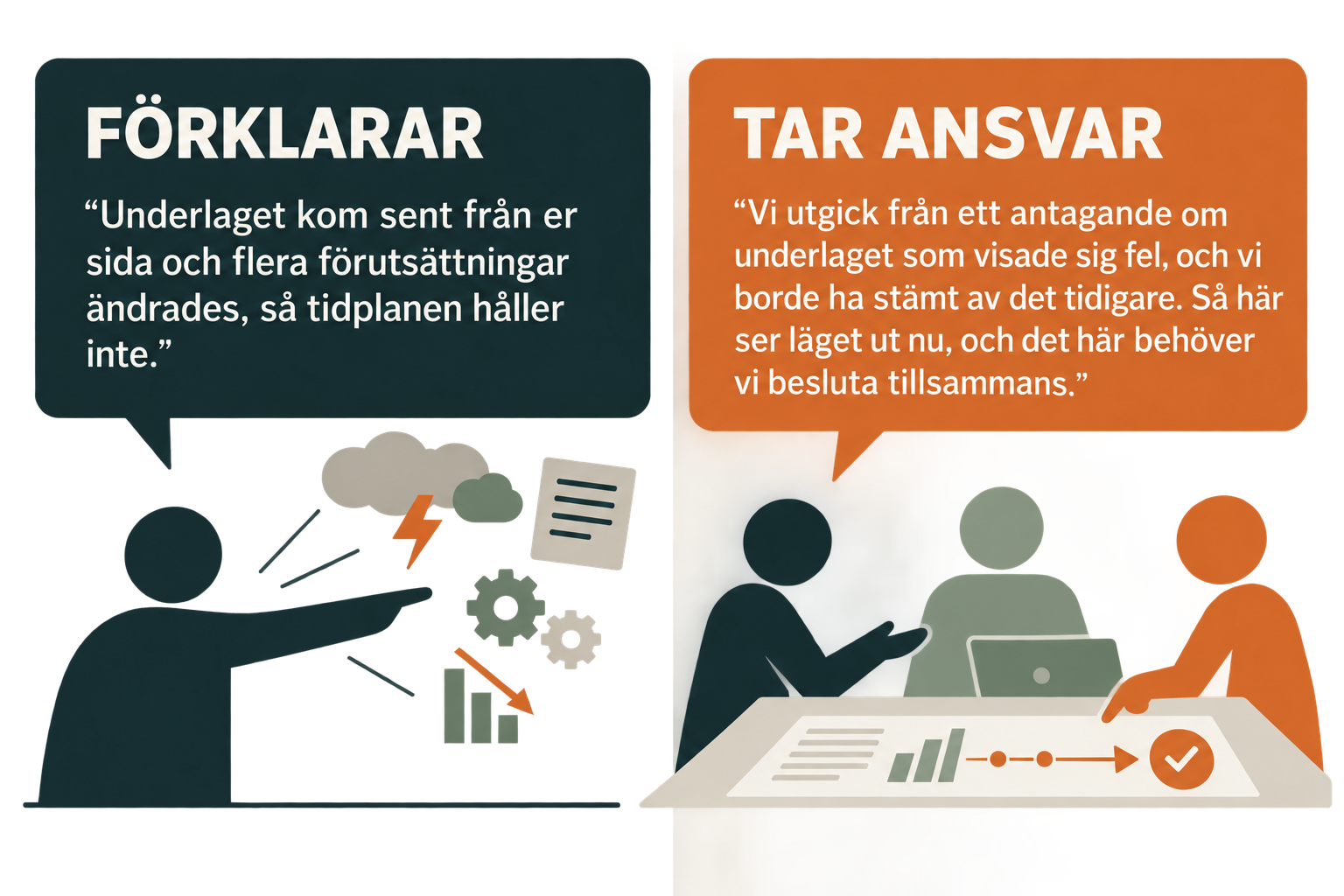
The same progress report, two ways.
What actually builds trust and drives progress
What is often difficult to accept is that transparency builds more trust than a polished narrative. Openly showing how we thought, what we didn’t understand and what we learnt does not signal weakness. It signals sound judgement, and that is precisely what lays the foundation for genuine collaboration.
“Transparency builds more trust than a polished narrative.”
Taking responsibility is a skill that improves with practice; it is not something you either have or lack. The best collaborations we have seen in our change management projects are not based on the idea that nobody ever makes mistakes. They are built on a shared language for dealing with difficult situations. When both we and the client take ownership of the situation – even when things haven’t gone to plan – we can maintain momentum and make the right decisions in good time, together.
Questions to bear in mind
- The last time you found yourself in a situation where something went wrong, what drove your initial reaction: curiosity or self-defence?
- The last time you had to explain why something took longer or went wrong, how much of what you said was about circumstances beyond your control, and how much was about what you yourself could have done differently?
- What can you do differently next time to move from explaining to taking responsibility?