In collaboration with a data centre company, Sigholm has carried out cost-benefit analyses of waste heat utilisation for planned facilities in two Swedish municipalities. Technically, it is possible to supply the waste heat to the district heating networks in both cases, but the socio-economic outcomes differ. The comparison gave the client a clearer picture of what determines whether waste heat from data centres is viable.
Cost-benefit analysis of waste heat for environmental permits
For the first project, the analysis was a requirement for the environmental permit. The Act (2014:268) on certain cost-benefit analyses in the energy sector and the Swedish Energy Agency’s regulations STEMFS 2014:3 require an analysis when a major source of waste heat is located near a district heating network. The facility in the second municipality fell just below the threshold values set out in the regulations. Nevertheless, the client chose to carry out the same analysis to gain an understanding of the possibilities.
The waste heat potential was calculated based on the data centre’s planned operations and compared with the energy companies’ existing district heating networks and costs. The heat pumps were sized for a realistic operating scenario to match the district heating network’s load profile, even though the data centres may, in the long term, supply more waste heat than the analysis anticipated. Investment levels and the technical solution were finalised through dialogue with the heat pump supplier, consultations with references, and close collaboration with the energy companies.
The production being replaced determines profitability
The cost-benefit analyses showed that waste heat supply was technically feasible in both municipalities, even though the local conditions differed and the technical solutions were therefore slightly different. The economic outcome, however, differed. In one municipality, waste heat supply was socio-economically justified, whilst in the other the calculation was negative but close to the break-even point. The main explanation is that the energy companies have different production systems and therefore the waste heat replaces different types of production.
In the analyses, waste heat has been valued at the marginal cost of the production it replaces. If the waste heat replaces low-cost production, the socio-economic revenue is small. If it replaces expensive peak and intermediate load sources, such as oil or pellets, the revenue is substantial.
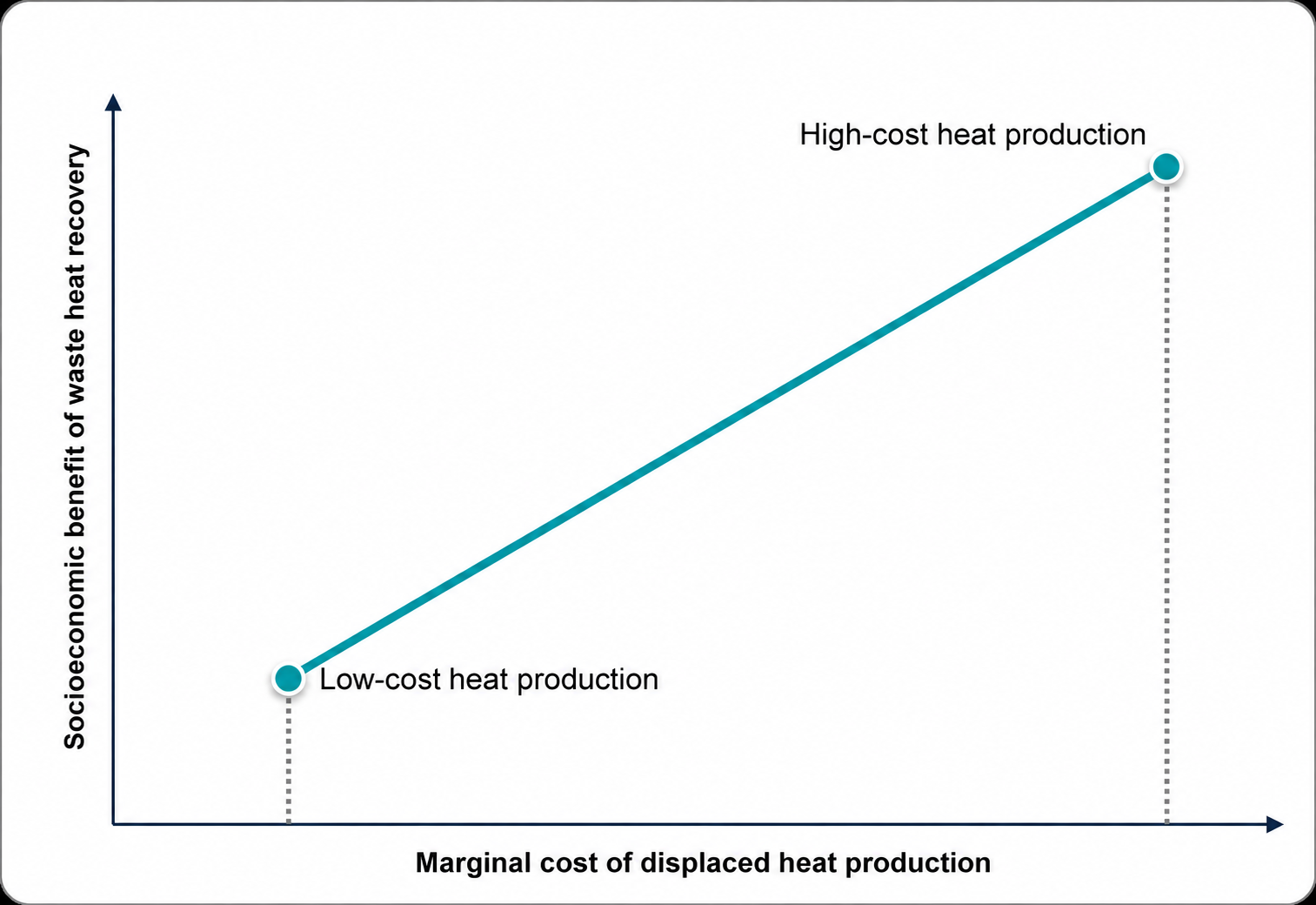
Figure: The same amount of waste heat supplied can generate different socio-economic benefits depending on the energy company’s production mix
In addition to this, the economic outcome is influenced by the temperature and output of the waste heat, the load profile and the distance to the grid – factors which also determine the design of the technical solution. To investigate the robustness of the results, sensitivity analyses were carried out in which the electricity price, the marginal cost of the production being replaced and the heat pump’s performance were varied, as these parameters have the greatest impact on the calculation. In one municipality, the positive result held true in almost all sensitivity analyses. In the other, the calculation became positive at a lower electricity price or a higher marginal cost.
A cost-benefit analysis is socio-economic in nature and therefore does not include energy tax on electricity, as taxes represent a redistribution between stakeholders rather than a cost to society. For the investor who will own the heat pump, however, the tax is a significant cost. This tax can be decisive in determining whether a project that is close to the break-even point goes ahead. In the Swedish Energy Agency’s analysis of the role of district heating and combined heat and power in the energy system, it is proposed that the energy tax on electricity be reduced for district heating heat pumps. This would improve the business case for investments such as these and, according to the Agency, make it easier to utilise waste heat and increase flexibility in the energy system.

